|
|
20世纪60年代之前,机器人的概念在很大程度上由好莱坞天马行空的想象所塑造。但随着计算机与各类技术取得进步,来自斯坦福国际研究院(SRI International)的人工智能(AI)领域先驱研究员Charles Rosen及其团队,将这份想象变为现实,并致力于突破机器人的能力边界。
他是斯坦福国际研究所人工智能研究中心的创始人,还领导了世界上第一个AI机器人Shakey的发明项目。
手机、全球定位系统(GPS)、扫地机器人以及自动驾驶汽车等无数技术的诞生,都要归功于Shakey带来的启发。
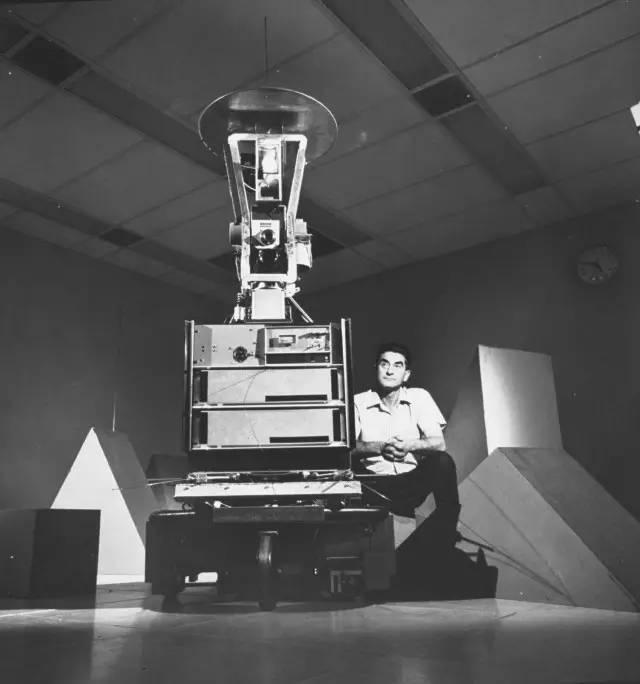
因其抖动的动作而被亲切命名的Shakey,于 1966 至 1972 年间在美国斯坦福国际研究院研发而成,它作为首台无需分步指令即可完成任务的人工智能移动机器人而闻名。
Rosen及其团队在研发Shakey机器人时取得的最大成就,或许是他们在人工智能技术、程序设计、计算机视觉、自然语言交互,以及机器人分层架构全新实现思路方面做出的开创性研究。这些算法至今仍给现代技术带来启发,并被应用于各类现代技术当中。
1917 年 12 月 7 日Charles Rosen出生于蒙特利尔。
Rosen先生少年时期来到美国,在纽约市的库珀联盟学院攻读电气工程专业。
他在雪城大学取得博士学位;
第二次世界大战期间,他回到加拿大,参与为英国交付的加拿大皇家空军飞机相关工作。
战争结束后,前往蒙特利尔的麦吉尔大学深造,并于 1950 年取得通信工程硕士学位。
后来他在纽约州斯克内克塔迪的通用电气研究实验室从事晶体管理论研究,并且是该领域早期著作《晶体管电路原理》的合著者。
这是一本早期极具影响力的晶体管应用教材,由 R.F. Shea主编,John Wiley & Sons国际出版公司发行。
在晶体管技术快速普及的背景下,该书推动了电路设计相关知识的传播。
在通用电气的这段经历夯实了他的电子学专业功底,他围绕半导体理论与器件性能开展研究,搭建起模拟系统与早期计算概念之间的技术桥梁。
1957年,他迁居加利福尼亚州,加入位于门洛帕克的斯坦福研究所,并迅速成为推动计算与工程研究领域的核心人物。
凭借其在通用电气任职期间积累的电子学相关经验,在此期间参与了神经网络相关项目,神经网络试图基于生物大脑的神经元组织结构构建计算机器,而非依靠只能实现开关两种状态的比特。
1963 年,Rosen在斯坦福研究所组建机器学习小组,这是该机构将人工智能研究工作制度化的早期重要一步。该举措为人工智能的大范围发展奠定基础;
20 世纪 60 年代初,他在斯坦福国际研究院主导研发了 MINOS 系列硬件神经网络,包括 1960 年的 MINOS I 与 1963 年的 MINOS II,用于字符与符号分类等模式识别任务。这些设备借鉴早期感知机理念,依靠自适应阈值与权重从数据中学习,在目标识别等军事场景中证明了技术落地的可行性。
1964 年完成的 MINOS III,能够在多种环境条件下高精度识别字母数字符号,取得显著成果,验证了自适应技术用于高鲁棒性模式处理的有效性。依托这些系统以及相关论文著作,Rosen大力倡导具备自我调节能力、受生物机制启发的架构,为该领域的联结主义模型以及反向传播算法的早期雏形奠定了理论基础。
1966 年,Rosen牵头成立斯坦福研究所人工智能中心(AIC),并出任该中心首任主任。
在他的带领下,人工智能中心发展成为全球顶尖的人工智能研究实验室之一,重点研究新兴技术的实际落地应用。为保障相关研究开展,Rosen成功争取到美国国防高级研究计划局(DARPA)的资金支持,其中 1966 年获得一笔数额达 75 万美元的重大资助,用于开展融合软硬件创新的前沿人工智能项目 。
沙基机器人项目于 1966 年在斯坦福国际研究院(SRI International)启动,由Charles Rosen牵头,Nils Nilsson担任首席研究员,项目经费由美国国防高级研究计划局(DARPA)提供。
该项目研制出全球首台通用移动机器人,它结合感知、规划与行动能力,可在非结构化环境中完成任务。身为斯坦福国际研究院人工智能中心负责人的罗森,管理这支跨学科团队,整合软硬件,打造出一套能够感知周边环境、执行复杂指令的系统。
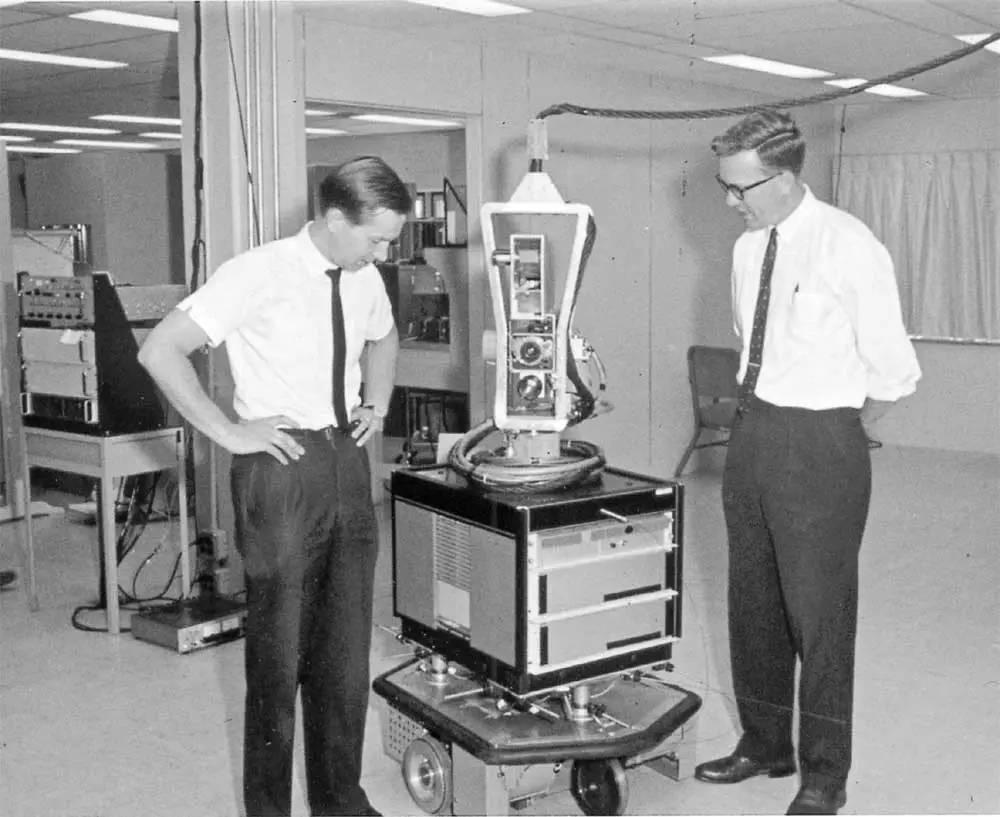
20世纪60年代末,斯坦福国际研究院(SRI)研究员Nils Nilsson(右)与Sven Wahlstrom站在机器人Shakey身旁。
照片来源:斯坦福国际研究院(SRI International)
项目负责人之一Peter E. Hart说:“基本准则是让它在机械结构上尽可能简单;这就是它没有机械臂,也没有对零部件进行小型化处理的原因。它看起来就像一台带轮子的洗衣机。”
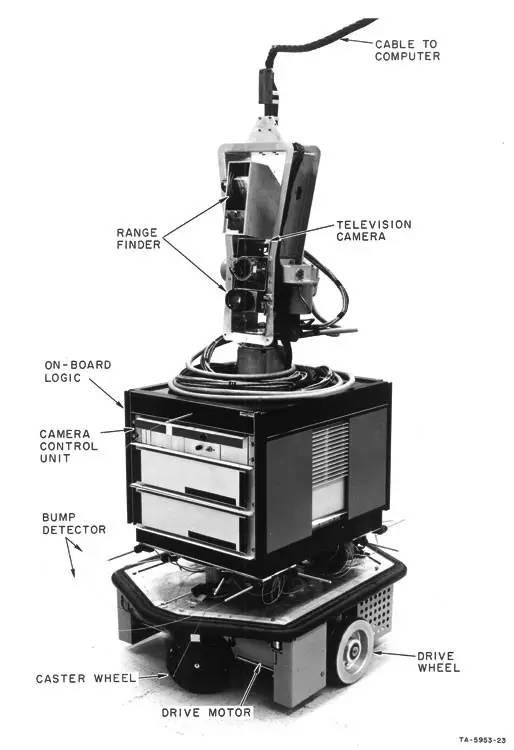
Shakey是一台带轮子的巨型箱式机器人,配备电视摄像机、红外三角测距仪、天线无线电通信链路、猫须式碰撞检测器,用于视觉感知周边环境,并弄清楚如何完成用户下达的任务。它通过定位物体、绕开障碍物,再对自身行为进行逻辑推理,以此完成对应任务。
Shakey身高约 2 米。轮式移动平台为机器人提供移动能力。
它便借助电视摄像机与测距仪扫描地标和物体,所有这些地标和物体都被涂成红色或黑色,方便Shakey的摄像机识别。

Shakey 机器人 “猫须式” 碰撞检测器与推挡杆的特写
面对诸如 “把方块推下平台” 这类任务,Shakey机器人无需像其他机器人那样接收一步步的指令,就能完成目标。它通过储备一系列简单动作, 例如滚动、转动、倾斜或转动摄像头,再将这些动作串联起来,以此完成更为复杂的任务。
Shakey还会记住过去执行过的多步骤方案,并能够调取或修改这些方案,用于处理后续任务。
该项目旨在融合人工智能的各类研究领域如逻辑推理、制定规划以及执行规划,同时结合计算机视觉与导航技术。
项目还运用了斯坦福研究所问题求解器,即STRIPS,这是一套自动规划系统,更为重要的是,它也是早期人工智能的典型实例。
STRIPS 允许程序员借助一套 using a system of “well-formed formulas来描述 “世界模型”,这套体系融合了对象、动作、前置条件与执行效果。通过该方法,系统会设定初始状态,并生成目标(包含基于相关动作的子目标)。该模型以前置条件与执行效果的核心思想为基础。例如你从 “门边” 出发,最终抵达隔壁房间。
项目最初使用一台 SDS(科学数据系统)940 计算机,大约在 1969 年,它被性能更强的 DEC PDP‑10 计算机所取代。
该计算机拥有 192K 字的 36 位存储器,时钟频率约 0.8 兆赫兹。一台冰箱大小的大型磁鼓存储器,用于在磁芯工作内存之间调入、调出分时任务
图像处理与决策运算通过无线链路在外部设备完成,路径规划耗时会随任务复杂度变化,从数分钟到数十分钟不等。
Rosen团队研发出颗粒度场景分析与简化表征技术,以此化解上述难题,在算力受限的条件下实现了阶段性技术突破。
后来换成PDP‑11计算机,该计算机可以处理传入的数据,并向控制机器人电机的电路发送指令。
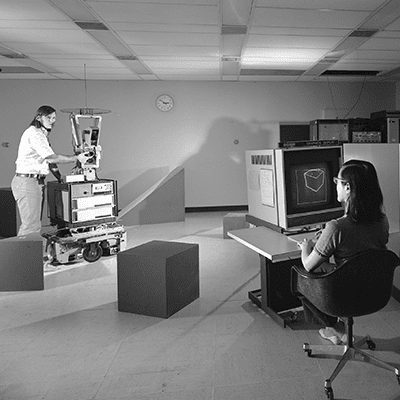
主要使用 Lisp 语言,这是最早的编程语言之一,但该机器人也使用 FORTRAN 语言,并且能够响应简单的英语指令。
其他指令包括平移、俯仰,此外还有 GOTO 语句,该语句会让 Shakey 在现实世界中移动到新位置,而非仅在代码中完成位置变动。
机器人自身会首先规划出它将要行进的路线,甚至会规划绕过障碍物的路径。它还可以完成搬箱子等其他实用任务。
机器人会寻找上面放有箱子的平台,一旦找到该平台,沙基就会找到斜坡并驶上平台,定位箱子,再小心地将它推下平台。
Shakey通过电传打字机和阴极射线管显示器与项目团队 “交流,有时,研究人员还会观察它面对恶作剧时的反应。
身着黑色斗篷的 Gremlin Charlie出场,把方块从Shakey的推杆上碰掉。
但Shakey的检测器检测到箱子位置发生变化后,便直接重新规划方案,继续完成工作。

该团队认为他们的机器人或许具备军事用途,项目负责人之一Nils Nilsson回忆道:“有人设想把这台机器人投放到中国的道路上,让它统计坦克数量。”Nils Nilsson解释道:“第一份合同周期约 18 个月,金额约 30 万美元。”
我们的项目经费续批到了1971年,之后美国国防高级研究计划局(DARPA)便下令‘不要再研发机器人项目’。”
Hert插话道:“这是因为‘曼斯菲尔德修正案’,” 他补充说,“该修正案要求美国国防部的研究必须和军事用途直接相关。
斯坦福研究院于 1970 年正式从斯坦福大学剥离;
1977 年,斯坦福研究院更名为 SRI 国际公司。
事实上,这款机器人在当时的理念远超所处时代。
例如,Shakey项目研发出了搜索算法。
由Peter E. Hart、Nils Nilsson与Bert Raphael于 1968 年联合研发,google过去七年机器人研究主管的评价称,Shakey机器人 “在半个世纪里都成为未来机器人系统的典范”。1962 年为Shakey机器人研发的、用于识别图像中点是否构成直线的算法,至今仍应用于自动驾驶汽车之中。
但该算法问世之初并未得到重视,项目负责人之一Peter E. Hart回忆道:“当时没有任何一本权威期刊愿意刊登我们的研究成果。”
Peter E. Hart后来担任理光公司高级副总裁。
“Bert Raphael为此十分恼火,索性创办了另一本人工智能期刊,也就是
《the Journal of Artificial Intelligence》,只为发表这篇论文。最终,这篇文章刊登在了电气和电子工程师协会汇刊上。”。
1970 年 11 月 20 日,《生活》杂志刊发长篇报道介绍了Shakey机器人。文章部分内容摘录如下:。
It looked at first glance like a Good Humor wagon sadly in need of a spring paint job. But instead of a tinkly little bell on top of its box-shaped body, there was this big mechanical whangdoodle that came rearing up, full of lenses and cables, like a junk sculpture gargoyle.
“Meet Shaky,” said the young scientist who was showing me through the Stanford Research Institute. “The first electronic person.”
I looked for a twinkle in the scientist’s eye. There wasn’t any. Sober as an equation, he sat down at an input terminal and typed out a terse instruction which was fed into Shaky’s “brain”, a computer set up in a nearby room: PUSH THE BLOCK OFF THE PLATFORM.
Something inside Shaky began to hum. A large glass prism shaped like a thick slice of pie and set in the middle of what passed for his face spun faster and faster till it dissolved into a glare then his superstructure made a slow 3600 turn and his face leaned forward and seemed to be staring at the floor. As the hum rose to a whir, Shaky rolled slowly out of the room, rotated his superstructure again and turned left down the corridor at about four miles an hour, still staring at the floor.“Guides himself by watching the baseboards,” the scientist explained as he hurried to keep up. At every open door Shaky stopped, turned his head, inspected the room, turned away and idled on to the next open door. In the fourth room he saw what he was looking for: a platform one foot high and eight feet long with a large wooden block sitting on it. He went in, then stopped short in the middle of the room and stared for about five seconds at the platform. I stared at it too. “He’ll never make it.” I found myself thinking “His wheels are too small. “All at once I got goose-flesh. “Shaky,” I realized, ”is thinking the same thing I am thinking!” Shaky was also thinking faster. He rotated his head slowly till his eye came to rest on a wide shallow ramp that was lying on the floor on the other side of the room. Whirring brisky, he crossed to the ramp, semi-circled it and then pushed it straight across the floor till the high end of the ramp hit the platform. Rolling back a few feet, he cased the situation again and discovered that only one corner of the ramp was touching the platform. Rolling quickly to the far side of the ramp, he nudged it till the gap closed. Then he swung around, charged up the slope, located the block and gently pushed it off the platform. Compared to the glamorous electronic elves who trundle across television screens, Shaky may not seem like much.
记者在当时的文章中写道:再过3-8年的时间,我们将创造出一台能够达到普通人类总体智力水平的机器。
No death-ray eyes, no secret transistorized lust for nubile lab technicians. But in fact, he is a historic achievement. The task I saw him perform would tax the talents of a lively 4-year-old child, and the men who over the last two years have headed up the Shaky project—Charles Rosen, Nils Nilsson and Bert Raphael—say he is capable of far more sophisticated routines. Armed with the right devices and programmed in advance with basic instructions, Shaky could travel about the moon for months at a time and, without a single beep of direction from the earth, could gather rocks, drill Cores, make surveys and photographs and even decide to lay plank bridges over crevices he had made up his mind to cross.
The center of all this intricate activity is Shaky’s “brain,” a remarkably programmed computer with a capacity more than 1 million “bits” of information. In defiance of the soothing conventional view that the computer is just a glorified abacus, that cannot possibly challenge the human monopoly of reason. Shaky’s brain demonstrates that machines can think. Variously defined, thinking includes processes as “exercising the powers of judgment” and “reflecting for the purpose of reaching a conclusion.” In some of these respects—among them powers of recall and mathematical agility–Shaky’s brain can think better than the human mind.
Marvin Minsky of MIT’s Project Mac, a 42-year-old polymath who has made major contributions to Artificial Intelligence, recently told me with quiet certitude, “In from three to eight years we will have a machine with the general intelligence of an average human being. I mean a machine that will be able to read Shakespeare, grease a car, play office politics, tell a joke, have a fight. At that point, the machine will begin to educate itself with fantastic speed. In a few months it will be at genius level and a few months after that its powers will be incalculable.”
I had to smile at my instant credulity—the nervous sort of smile that comes when you realize you’ve been taken in by a clever piece of science fiction. When I checked Minsky’s prophecy with other people working on Artificial Intelligence, however, many of them said that Minsky’s timetable might be somewhat wishful—”give us 15 years,” was a common remark—but all agreed that there would be such a machine and that it could precipitate the third Industrial Revolution, wipe out war and poverty and roll up centuries of growth in science, education and the arts. At the same time, a number of computer scientists fear that the godsend may become a Golem. “Man’s limited mind,” says Minsky, “may not be able to control such immense mentalities.”
Marvin Minsky of MIT’s Project Mac, a 42-year-old polymath who has made major contributions to Artificial Intelligence, recently told me with quiet certitude, “In from three to eight years we will have a machine with the general intelligence of an average human being. I mean a machine that will be able to read Shakespeare, grease a car, play office politics, tell a joke, have a fight. At that point, the machine will begin to educate itself with fantastic speed. In a few months it will be at genius level and a few months after that its powers will be incalculable.”
I had to smile at my instant credulity—the nervous sort of smile that comes when you realize you’ve been taken in by a clever piece of science fiction. When I checked Minsky’s prophecy with other people working on Artificial Intelligence, however, many of them said that Minsky’s timetable might be somewhat wishful—”give us 15 years,” was a common remark—but all agreed that there would be such a machine and that it could precipitate the third Industrial Revolution, wipe out war and poverty and roll up centuries of growth in science, education and the arts. At the same time, a number of computer scientists fear that the godsend may become a Golem. “Man’s limited mind,” says Minsky, “may not be able to control such immense mentalities.”
Marvin Minsky of MIT’s Project Mac, a 42-year-old polymath who has made major contributions to Artificial Intelligence, recently told me with quiet certitude, “In from three to eight years we will have a machine with the general intelligence of an average human being. I mean a machine that will be able to read Shakespeare, grease a car, play office politics, tell a joke, have a fight. At that point, the machine will begin to educate itself with fantastic speed. In a few months it will be at genius level and a few months after that its powers will be incalculable.”
I had to smile at my instant credulity—the nervous sort of smile that comes when you realize you’ve been taken in by a clever piece of science fiction. When I checked Minsky’s prophecy with other people working on Artificial Intelligence, however, many of them said that Minsky’s timetable might be somewhat wishful—”give us 15 years,” was a common remark—but all agreed that there would be such a machine and that it could precipitate the third Industrial Revolution, wipe out war and poverty and roll up centuries of growth in science, education and the arts. At the same time, a number of computer scientists fear that the godsend may become a Golem. “Man’s limited mind,” says Minsky, “may not be able to control such immense mentalities.”
Marvin Minsky of MIT’s Project Mac, a 42-year-old polymath who has made major contributions to Artificial Intelligence, recently told me with quiet certitude, “In from three to eight years we will have a machine with the general intelligence of an average human being. I mean a machine that will be able to read Shakespeare, grease a car, play office politics, tell a joke, have a fight. At that point, the machine will begin to educate itself with fantastic speed. In a few months it will be at genius level and a few months after that its powers will be incalculable.”
I had to smile at my instant credulity—the nervous sort of smile that comes when you realize you’ve been taken in by a clever piece of science fiction. When I checked Minsky’s prophecy with other people working on Artificial Intelligence, however, many of them said that Minsky’s timetable might be somewhat wishful—”give us 15 years,” was a common remark—but all agreed that there would be such a machine and that it could precipitate the third Industrial Revolution, wipe out war and poverty and roll up centuries of growth in science, education and the arts. At the same time, a number of computer scientists fear that the godsend may become a Golem. “Man’s limited mind,” says Minsky, “may not be able to control such immense mentalities.”
This fall, Minsky and a colleague named Seymour Papert opened a two-year crash attack on the learning problem by trying to teach a computer to understand nursery rhymes “It takes a page of instructions,” says Papert, “to tell the machine that when Mary had a little lamb she didn’t have it for lunch.”
Bert还记得,有一些 “工会人员” 前来拜访他们…… 这些人想知道机器人技术和自动化是否会扰乱就业。

Rosen对人工智能领域多位关键人物的指导,造就了下一代科研工作者。
他曾指导Nils Nilsson在 1985 至 1990 年间出任斯坦福大学计算机科学系主任;
同时也指导过Peter E. Hart机器智能公司联合创始人。
Peter E. Hart认为Rosen是对自己影响最大的导师,是他培养了自己的创新思维以及人工智能开发工作中的伦理意识 。
依托这些学术人脉,Rosen参与撰写了多部机器学习与机器人学领域的重要著作,深刻影响了斯坦福大学等院校的人工智能与机器人专业课程体系。
Rosen为美国国家航空航天局等政府机构提供顾问服务,这也体现出他持续推动智能系统相关教育与政策发展的重要作用 。
Rosen的研究不局限于Shakey机器人这类具体项目,在该项目中,他的方法实现了感知与规划的早期融合;
他还在更广的理论层面倡导,将启发式编程与模式识别作为人工智能的基础。
20 世纪 60 至 70 年代,相较于纯算法方法,他更推崇启发式方法,即依靠经验法则的策略,让机器能够在复杂、不确定的环境中求取近似解,他认为这类方法可以模拟人类高效的推理模式。这一观点影响了他主导下斯坦福国际研究院的各类报告与项目提案,这些文档将启发式编程视作现实场景下可扩展人工智能应用的关键,也对后续搜索算法与问题求解框架的研究产生了影响 。
除了深耕神经网络领域的研究外,Rosen还涉足葡萄酒酿造行业。
1959年,Rosen先生与斯坦福研究院的同事Hewitt Crane以及David Bennion在圣克鲁兹山脉购入一片占地40英亩的葡萄园,此地俯瞰着日后闻名于世的硅谷。
此后数年,他们仅利用周末修缮这片庄园,并将其命名为Ridge酒庄。
几位创始人将自身工程与科学专业背景运用于葡萄种植,推崇一种 “少干预” 理念,尽量减少人为介入,以此保留葡萄本身的天然特质,同时搭配适配当地陡峭、石灰岩密布梯田地貌的传统种植工艺 。其中就包括在圣克鲁斯山区开创旱作种植技术,依靠自然降雨与深根葡萄藤提升果实风味浓郁度,全程不进行人工灌溉。
酒庄少量自产葡萄酒供自己饮用,绝大多数葡萄则售予其他酿酒商。
在他们的经营下,凭借声名卓著的仙粉黛葡萄酒与赤霞珠葡萄酒,助力复兴了加利福尼亚州圣克鲁兹山脉的高端葡萄酒酿造产业。
获得行业广泛认可,还加入了加州可持续葡萄种植联盟 。
Ridge葡萄园在1976 年巴黎葡萄酒品鉴大赛中取得了第五名的成绩,直至1986年酒庄被一位日本实业家收购,Rosen与妻子布兰奇始终参与酒庄的经营事务。
罗森夫人于当年6月离世,二人相伴走过了60年婚姻岁月。
1978 年Rosen从研究院退休后,Rosen与斯坦福研究院及其他机构的同事共同创立了机器智能公司(MIC)。
他担任该公司的首任首席执行官,机器智能公司在他的车库中研发出了首款商用工业机器视觉系统VS‑100,该公司后于1982年分拆成立了赛门铁克公司。
1983 年,罗森荣获约瑟夫・F・恩格尔伯格机器人技术开发奖,该奖项是机器人领域的重量级荣誉,由机器人工业协会(现隶属于 A3)颁发,用以表彰他在移动自主系统以及自动化领域人工智能应用方面做出的奠基性工作
1990年,Rosen成为美国人工智能协会的创始会员。
晚年,他发明了一款针对肺气肿治疗的靶向药物吸入装置,该装置由另一家企业实现商业化生产。
2002年12月8日Rosen因肺炎在加利福尼亚州阿瑟顿市去世,身后留有两个儿子、两个女儿以及五位孙辈。
Shakey在人工智能与机器人领域开拓全新前沿后正式退役,如今安家于加利福尼亚州山景城的计算机历史博物馆。
2004 年,Shakey实至名归入选卡内基‑梅隆大学机器人名人堂,
2017年还荣获了颇具声望的 IEEE 电气与计算工程里程碑奖,据《IEEE综览》报道,1983年启动的IEEE里程碑项目,旨在表彰“电气工程与计算机领域造福人类的重大发明、地点或事件”。
在过去34年间,该项目已经认定了174项工程史上的重要成就,现在轮到了机器人Shakey。

2017年Shakey的里程碑纪念牌匾将被安置在其研发机构,位于加利福尼亚州门洛帕克的SRI国际研究所的主大厅内,紧邻一块纪念1969年阿帕网诞生的牌匾。
这块铭牌向好奇的参观者介绍,Shakey机器人“能够感知周边环境,从已知事实推导出隐含事实,制定行动方案,修正方案执行过程中出现的错误,并使用日常英语进行交流。”
官方纪念铭牌上写道:“Shakey机器人的软件架构、计算机视觉以及导航与规划方法,在机器人技术,以及网络服务器、汽车、工厂、电子游戏和火星探测器的设计领域都具有开创性意义。”
自 1966 年以来,Shakey机器人项目已被 2115 多项美国专利以及近 5000 篇研究论文引用。
Shakey的第一个 “后代” 是 “Flakey,机器人,该机器人运用模糊逻辑与面向目标的行为模式。
而Shakey的 “孙辈” 是 “群体机器人”,这是一项自主集群机器人项目,动用 100 台机器人协同作业,完成区域测绘工作。
在比尔・盖茨参与的SVA 演讲系列访谈中,可查看他谈及Shakey的人工智能技术如何在年少时给他带来启发的相关内容:“软件领域的终极目标就是人工智能,无论是纯软件形态的智能,还是实体机器人形态的智能。上世纪 60 年代,斯坦福国际研究院(SRI)研发出了机器人Shakey。我记得自己上十年级时见到它,当时就心想:‘这就是我想要钻研的方向,把这款机器人做得更完善。’”
计算机历史博物馆主席Len Shustek开了当晚活动的序幕,回忆起他在斯坦福大学的时光,那时 “我们所有人都知道Shakey机器人”。他补充道:“它在我们心中就是一个传奇。”
IEEE 主席Jim Jefferies,在该仪式上发言指出,本次授牌是第 174 项获表彰的工程历史成就,同时也是 IEEE 圣克拉拉谷分会获得的第 12 项里程碑认定。
|
|
 |小黑屋|手机版|Archiver|机械荟萃山庄
( 辽ICP备16011317号-1 )
|小黑屋|手机版|Archiver|机械荟萃山庄
( 辽ICP备16011317号-1 )


 发表于 2026-8-16 19:25:27